
For people who already hold XMR and want the purchase to leave as little public record as the tool honestly allows.
VPN that accepts Monero
XMR is one of the twelve coins at checkout. What paying in Monero actually changes, what it leaves exactly as it was, and when a different coin serves you better.
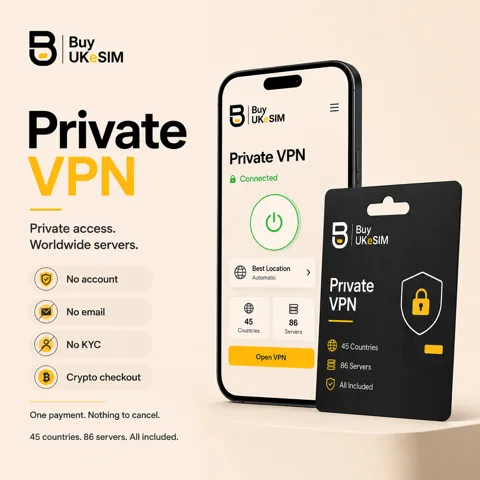
- XMR is one of 12 coins at checkout, with no account and no email required
- Monero hides sender, recipient and amount at the protocol level, so the payment is not a public ledger entry
- It does not hide the order itself, your IP, or an exchange withdrawal you made to fund it
- Confirmation runs a few minutes longer than TRC20; never send a second payment while it confirms
- The whole store, including checkout and delivery, is mirrored on a Tor onion service linked in the footer
- One XMR payment can cover the VPN and an eSIM on the same order and the same magic code
Monero sits at checkout next to the other eleven coins, and the flow is identical: pick a plan length, pick XMR, send the quoted amount, wait for confirmation, and the order page opens with your credentials and configuration files. There is no account, no email requirement and no extra step for paying in Monero.
The reason people look for it specifically is the ledger. On Bitcoin, Ethereum or Tron, a payment is a permanent public entry with an amount, two addresses and a timestamp that anyone can read years later. Monero is built so that entry is not there to read.
That is worth something, and it is worth less than the marketing around it suggests. This page splits the two: the part Monero genuinely changes, and the part that stays exactly the same no matter which coin you send.
Related guides: Paying for a VPN with Monero, USDT or Bitcoin →
What Monero changes compared with a transparent chain
A USDT or BTC payment writes a row that never goes away. The sending address, the receiving address, the amount and the time are public, and anyone who later learns that one of those addresses is yours can read backwards and forwards through everything else it ever did. That is not a flaw in those chains; it is how they are designed to work.
Monero conceals the sender, the recipient and the amount at the protocol level, so the payment does not become a public row that links your wallet history to this order. Nobody browsing a block explorer can see that a payment of this size went to this destination at this time.
In practice that means one specific thing: the purchase does not add a permanent, publicly readable entry connecting your funds to a VPN provider. If that is what you came for, XMR is the right coin here and it is offered for exactly that reason.
What Monero does not change
An order still exists. Paying in XMR does not skip the order record: there is a plan length, a pair of timestamps, the credentials issued for your VPN account, and a magic code. That record is deliberately thin, and it is the same record every coin produces, but pretending it is not there would be dishonest.
Your visit still comes from an IP address. Loading this page, paying and opening your order page are ordinary web requests, and a web server sees where a request came from. If that matters to you, use Tor. The whole store is mirrored on an onion service, linked in the footer of every page, and the catalogue, the checkout and the delivery all work end to end inside it.
And where the coins came from still matters. If you bought XMR on an exchange that knows who you are and withdrew it straight to the payment address, that exchange holds its own record of the withdrawal, its size and its timing. Monero protects the chain, not the account you bought it in. Nothing about the coin fixes that step, and no provider can fix it for you.
Why the order page sits on waiting longer with XMR
Monero blocks arrive roughly every couple of minutes and the payment gateway waits for its own confirmation count before it releases anything, so an XMR payment usually clears a few minutes later than a TRC20 transfer. The order page shows waiting first, then confirming, then paid. Waiting means nothing has been seen yet; confirming means the network is counting.
That gap is where people make the expensive mistake of sending a second payment. Do not. A duplicate arrives as a separate transaction that has to be untangled by hand, and if the payment window has already expired, the funds are never released automatically. Wait out the confirmation, and if the window closes first, write to support with the transaction details.
Two practical notes. Send the exact quoted amount in a single transaction: a payment split in two, or an underpayment topped up later, leaves the invoice short. And if you are withdrawing from an exchange rather than sending from your own wallet, expect the exchange to add its own delay before the transaction is even broadcast.
When USDT on TRC20 is the better choice
If your reason for using crypto is that you do not want a card involved, rather than that you specifically want chain privacy, then USDT or TRX on TRC20 is the better tool. It is usually the cheapest to send, it confirms in a couple of minutes, and because it is a stablecoin the quoted amount does not drift while you find your wallet.
There is also a practical limit at the short end. Every coin has a minimum the payment gateway will accept, and on the shortest plans some coins fall under it and appear greyed out. If XMR is unavailable on the plan you picked, that is why, and choosing a longer plan or a different coin fixes it.
Saying this costs us nothing, which is why you should trust it: the plan, the servers and the protocols are identical whichever coin you send. Pick Monero because you want what Monero does, not because it is the option a page like this is supposed to push.
What the VPN itself does, separately from how you paid
The coin you pay with and what the VPN does are unrelated. The VPN encrypts traffic between your device and the server you chose, so the local network and your ISP see a connection to that server and not the sites beyond it, and the services you visit see the server IP rather than yours.
It does not make you anonymous. Accounts you log into still know who you are, your browser is still your browser, and a VPN moves trust rather than removing it: instead of trusting the network you are sitting on, you trust the VPN network. Our servers run without persistent disks and the network is operated so that source IP addresses and connection timestamps are not stored, but that is a statement about how it is run, not a proof you can audit.
Paying in Monero is therefore one honest piece of a larger picture, not the whole of it. It removes a public financial link between you and this service. Everything after that depends on how you use the connection.
Buying an eSIM with Monero at the same time
The VPN can be added at UK number or travel eSIM checkout, which means one XMR payment can cover a real +44 line, prepaid data or both, along with the VPN, on a single order.
The result is one magic code that opens the eSIM QR and the VPN configs on the same order page, and one transaction on chain instead of two or three. Details of the eSIM side are on /anonymous-esim/ and /no-kyc-esim/.
One rule for that combination: switch the VPN off before you scan an eSIM QR. The profile download has to reach the operator directly, and a VPN, proxy or private relay in the path makes the install fail. Turn it back on once the eSIM is installed.
Pay for a VPN plan with Monero
- 1
Pick a plan length
Choose 7, 15, 30, 90, 180 or 365 days on /vpn/. Every plan carries every server and all three protocols, so the length is the only decision.
- 2
Select XMR at checkout
Monero is one of the twelve coins. If it is greyed out, the plan total is below the gateway minimum for XMR, so pick a longer plan or another coin.
- 3
Send the exact amount
Send the quoted XMR figure in one transaction from your wallet. Do not split it, and do not round it down.
- 4
Wait through the confirmation
XMR clears a few minutes slower than most coins. The page moves from waiting to confirming to paid. Do not send a second payment while it is confirming.
- 5
Save your magic code
The order page issues an 8-character code that opens your username, password, expiry date and the config for every server. It is the only key, so store it somewhere durable.
Questions & answers
Can I pay for a VPN with Monero?
Yes. XMR is one of the twelve coins at checkout and needs no signup, no email and no extra verification. Pick a plan length, select Monero, send the quoted amount, and the order page opens with your credentials and configuration files once it confirms.
What does paying in Monero actually hide?
Monero conceals the sender, the recipient and the amount at the protocol level, so the payment does not become a permanent public entry the way a Bitcoin or USDT transfer does. Nobody reading a block explorer can link your wallet history to this purchase.
What does Monero not hide?
It does not remove the order record we create, which holds a plan length, timestamps, your VPN credentials and a magic code. It does not hide the IP address your requests come from, and it does not hide a withdrawal from an exchange that already knows who you are.
How long does an XMR payment take to confirm?
Usually a few minutes longer than a TRC20 transfer, because Monero blocks arrive roughly every couple of minutes and the gateway waits for its own confirmation count. The order page shows waiting, then confirming, then paid. Do not send a second payment during that window.
Is USDT cheaper and faster than Monero here?
Yes. USDT or TRX on TRC20 is usually the cheapest to send and confirms in a couple of minutes, and being a stablecoin the quoted amount does not move while you pay. Choose Monero if you specifically want the chain privacy, not for speed or fees.
Why is Monero greyed out on the plan I picked?
Every coin has a minimum the payment gateway will accept, and on the shortest plans the total can fall below the minimum for XMR. Nothing is wrong on your side. Choose a longer plan or a different coin and the option becomes available.
Can I buy over Tor as well as pay in Monero?
Yes. The whole store is mirrored on an onion service linked in the site footer, and the catalogue, checkout and delivery all work inside it end to end. Combining Tor for the connection with Monero for the payment covers both legs rather than only one.
Does paying with Monero make my VPN usage anonymous?
No. It separates the purchase from a public financial trail, which is a real benefit, but it changes nothing about the connection itself. A VPN moves trust from your local network to the VPN network, and accounts you log into still know who you are.
More topics
Related guides
VPN that accepts Monero
XMR is one of the twelve coins at checkout. What paying in Monero actually changes, what it leaves exactly as it was, and when a different coin serves you better.
See VPN plans