
For buyers who do not want a name, a mailbox or a card attached to a VPN subscription, anywhere in the world.
Anonymous VPN: what is actually anonymous
An anonymous purchase and anonymous browsing are two different problems. This page separates them and says which one we solve.
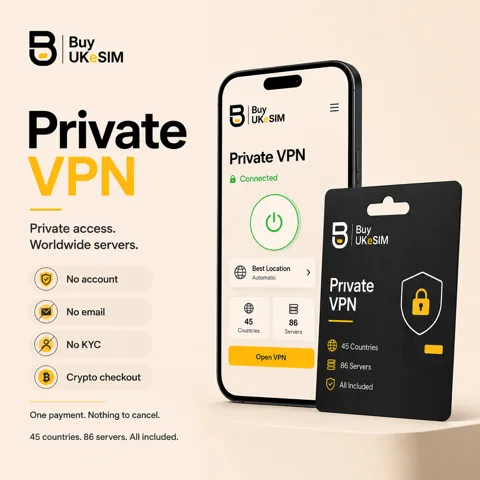
- No signup, no email required, no password, no card, no billing address, no KYC
- An 8-character magic code is the credential, in place of an identity
- Our record is one order row that names nobody, unless you chose to leave an email
- Crypto only, with Monero for a payment that stays private
- The whole store is reachable over Tor, including an onion service
- A VPN is not anonymity from a site you log into, and we will not pretend otherwise
- 5 simultaneous connections, every server we list, P2P allowed
The word "anonymous" is doing two jobs in this market, and providers benefit from the confusion. One job is the purchase: whether anyone can tell that you are the person who owns this subscription. The other is the browsing: whether anyone can tell what you did while connected. They are separate problems with separate answers, and a provider can be excellent at the first while being irrelevant to the second.
We are unusually good at the first. There is no signup, no email required field, no password, no card and no billing address at checkout, so the record on our side has no identity in it. That is a real and uncommon thing, and it is also the limit of what we can honestly claim.
Below: the four layers that leak, exactly what our checkout removes, what it cannot touch, and the strongest configuration we can honestly describe for someone who wants one.
The four layers, and what each one gives away
The payment layer. A card carries your legal name, your bank and a line on a statement someone else can subpoena. Crypto removes the card but does not automatically remove the trail: coins bought on an exchange that verified your passport carry that verification to the address you send from, and a transparent chain keeps that hop permanently. Monero is the one that does not work this way.
The account layer. An email address is a permanent handle, and it is the single field most providers ask for. It links this purchase to your next one, survives in a breach dump, and usually resolves back to a mailbox with your real name on it. A password reset trail does the same job again.
The network layer. Without a tunnel your internet provider sees every destination. With one it sees an encrypted session to a single endpoint, and the destinations are visible to the VPN server instead. The site you visit sees a shared exit address rather than the one your provider issued you.
The identity layer, which is the one nobody sells you anything for. A logged-in account, a cookie you were already carrying, a browser fingerprint, an installed font list, a device language. All of that arrives with you and all of it is unchanged by any tunnel.
What our checkout genuinely removes
There is no sign-up. Not an optional account, not a "guest checkout that creates an account anyway": there is no account system on the site. Nothing to log into means no login history, no password reset trail and no mailbox tied to a subscription.
There is no email field required to buy, no phone number, no name, no card and no billing address, and there is no KYC of any kind. You choose a plan length, you pay once in crypto, and the order page is opened afterwards with an 8-character magic code. That code is the credential in place of an identity.
What that leaves behind is one order row: the plan, when it was created, when it expires, the payment reference, the code, and an email only if you chose to leave one. Leave no email and nothing in it names anybody, which means there is nothing to hand over that would.
What it cannot remove, stated plainly
The payment exists. A crypto payment passes through a gateway that sees the transaction, and on a transparent chain it is publicly recorded forever. If the coins came from an account in your name, that link is outside our reach and always will be.
Your address when you visit the site. Buying over the ordinary web means our server and the network in front of it handle a request from wherever you are. Tor removes that, which is why the whole store is reachable over an onion service.
Everything above the network. A VPN does not log you out of your accounts, does not clear your cookies, does not change your fingerprint and does not stop a service you sign into from knowing exactly who you are. Nobody can sell you anonymity from a service you voluntarily identify yourself to.
The strongest setup we can honestly offer
Reach the site over Tor Browser, including the onion address, so the visit itself is not attached to your home connection. Pay in Monero, or from a wallet with no verified-exchange history behind it. Type no email anywhere. Save the magic code offline, because it is the only way back into the order and there is deliberately no reset.
Then keep the uses separate. Use a distinct browser profile for whatever you wanted unlinked, and do not sign into your daily accounts through the same session. This is the step people skip, and it is the step that undoes all the others.
None of this makes anyone untraceable, and if a page tells you otherwise it is selling. What it does is leave the smallest realistic set of records: no identifier with us, no traceable payment on a public chain, no home address in the visit, and no source addresses or connection timestamps on the network.
Where the VPN sits next to the eSIM products
The same checkout logic runs the rest of the store. A UK +44 number and a travel data eSIM are bought the same way, with no account and no KYC, and the VPN can be added to either at checkout so one payment and one magic code cover both.
They solve different halves of the same problem. The number gives you an identifier to hand to services that demand a phone number without handing over your personal one. The VPN changes what your carrier or the network you are on can see about where your traffic goes. Neither is a substitute for the other.
Buy a VPN with the fewest identifiers attached
- 1
Open the site over Tor
Use Tor Browser, or our onion service directly, so the purchase visit is not attached to your home connection.
- 2
Choose a plan length
7 to 365 days. No auto-renewal, no card stored, nothing recurring that would need a cancellation later.
- 3
Pay in Monero if the payment matters
A dozen coins are accepted. Monero keeps the payment itself private; anything on a transparent chain is a permanent public record.
- 4
Give no email
Nothing on the checkout requires one. If you never type it, we never have it, and it cannot be handed over or leaked.
- 5
Store the magic code offline
The 8-character code is the only way back into your order page. There is no account recovery, which is the cost of having no account.
- 6
Keep identities apart
Connect, then use a separate browser profile for whatever you wanted unlinked. Signing into your usual accounts through the tunnel undoes every step above it.
Questions & answers
Is a VPN anonymous?
Not on its own. It changes who can see what: your internet provider stops seeing your destinations and the VPN server sees them instead. Any service you sign into still knows exactly who you are, regardless of the address you arrive from.
Do I have to give an email address?
No. There is no email field required to buy and no account to create. Your order page is opened with the 8-character magic code from checkout, and if you never type an email we never hold one.
Could you tell who bought a particular VPN plan?
Our record is a single order row containing the plan, the dates, a payment reference and the magic code, with no name or card, and an email only if you left one. The payment itself passes through a crypto gateway, and on a transparent chain that transaction is public.
Which coin is the most anonymous to pay with?
Monero, because the sender, the receiver and the amount are hidden by design. Bitcoin, the stablecoins and the rest are recorded on public ledgers where a payment can be traced and later linked to whoever bought the coins.
What happens if I lose the magic code?
There is no password reset, because there is no account and no email to send a reset to. Storing the code offline is the trade you make for a purchase that carries no identity. Save it before closing the tab.
Can I buy over Tor?
Yes. The whole store works over Tor, including an onion service, so the purchase visit carries no home address. Combined with Monero and no email, that is the most private path we can offer.
Does the VPN hide me from a website I log into?
No, and no VPN does. Signing in identifies you by definition. A tunnel changes the address the site records, not the account you handed it.
How many devices can use one purchase?
Up to 5 at the same time, with one set of credentials that works on every server we list. Bandwidth is not metered and P2P is allowed.
More topics
Related guides
Anonymous VPN: what is actually anonymous
An anonymous purchase and anonymous browsing are two different problems. This page separates them and says which one we solve.
See VPN plans