
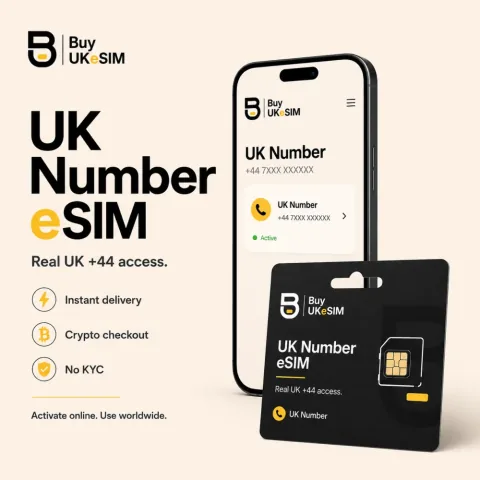
BuyUKeSIM is one option in this list: a real UK +44 carrier line as an eSIM, $25 once with six months included, unlimited incoming SMS and calls, no mobile data.
Free Virtual Number for SMS Verification
There are four different things people call a virtual number, and picking the wrong one is why codes stop arriving.
- Public inboxes: free, instant, publicly readable, heavily blocklisted. Correct for throwaway accounts.
- Free app numbers: private inbox, no cost, but reclaimed for inactivity, and inbound messages typically do not count as activity.
- Rented code services: cheap and quick, but the number goes back to a shared pool when the window ends.
- Real carrier line: not shared, no pool, no reuse history, and still yours at re-verification time.
- Match the number type to the lifespan of the account, not to the price of the code.
- Our UK +44 line is $25 once with six months included, unlimited incoming SMS and calls worldwide, crypto only, nothing auto-renews.
The phrase virtual number covers at least four unrelated products, and they behave nothing alike. A public inbox on a website, a free app line, a rented number from a code-selling service, and a real carrier line issued to you are all sold under the same two words. Most disappointment with SMS verification comes from buying or using one type while expecting the properties of another.
This page sorts them out. It says which ones are free, which ones survive a platform's filters, and which ones you still hold in a year. Free genuinely wins some of these comparisons, and we say so, because a page that pretends otherwise is not worth reading. The useful skill is matching the type of number to how long you need the account to last.
Type one: public receive-SMS websites
These publish a handful of live numbers and display every incoming message on a public page. No signup, no payment, no app. They are the fastest route to a single code and cost nothing, which makes them the right tool for a genuinely disposable signup.
Their limits follow directly from the design. The inbox is public, so any code is readable by anyone watching, and the number is shared, so it carries an enormous registration history. Platforms use exactly that history to decide whether to send anything at all. Expect a fair share of numbers to be dead on arrival, and expect to rotate. Since rotating is free, that is an annoyance rather than a cost.
Type two: free app numbers
Services such as TextNow and TextFree issue a free line inside an app, funded by advertising. Unlike a public inbox, the number is yours alone while you hold it, which removes the shared-inbox problem entirely. For casual use, that is a real improvement at zero cost.
The catch is tenure. Free app numbers are reclaimed for inactivity, and TextNow's own guidance is that outgoing activity keeps a number alive while incoming messages do not. In other words, a number kept purely to receive verification codes is exactly the usage pattern that gets it recycled. These lines are also delivered over internet telephony, which some platforms filter on principle.
Type three: rented numbers from code services
Paid services rent you a number for a few minutes to receive one code, often priced per service. They are cheap, they are quick, and for bulk or one-shot verification they do a specific job that free public sites do less reliably.
You are renting access to a code, not acquiring a line. When the rental window closes the number returns to the pool and may be rented to someone else, including for the same platform. Any account tied to it inherits that instability. Treat this category as a slightly more reliable version of a public site rather than as a way to own a number.
Type four: a real carrier line
The last category is a mobile number issued by an actual network operator and held by you. It is not shared, it does not return to a pool on a timer, and it has no mass-registration history behind it. That combination is the only one that survives re-verification a year later, because you still hold the number when the platform asks for it again.
Ours is a United Kingdom +44 mobile line delivered as an eSIM QR, with unlimited incoming SMS and calls worldwide over roaming and no mobile data. It is $25 once, first six months included, then $15 every six months, paid in crypto, with no signup, no email required, and no stored card. We never guarantee that a given app will accept a given number, and there are no refunds for app rejection, so treat it as buying a line rather than buying an outcome.
Why free public numbers stop working, mechanically
There are three separate mechanisms and they fail at different times. The first is the shared inbox. A public number displays every message it receives on an open web page, so the code is not private at the moment it arrives, and neither is anything sent to that number afterwards. Nothing is broken here, it is how the product is built.
The second is range reputation. Platforms score an incoming verification request against the number's history, and public numbers have been used for signups thousands of times, often across several sites listing the same line. Once the count crosses a threshold the platform simply stops delivering, and because the decision attaches to the number rather than to your attempt, retrying is wasted effort. Whole ranges are sometimes filtered together, which is why a different country can succeed where a different number does not.
The third is ownership, and it is the one people discover late. You never held the number, so when a service asks for it again at a new-device login, a session reset, or a password reset, there is nothing to receive on. The account does not fail loudly at that point. It simply cannot be recovered, and if the number has been recycled, the recovery code reaches whoever holds it now.
How to pick without overthinking it
Ask one question: if this account vanished in six months, would it matter? If the honest answer is no, use a free public site and spend nothing. That covers test accounts, one-off content unlocks, and anything you are only touching once. Paying for those is money set on fire.
If the answer is yes, the requirement is not a code but continuity of control, and only a line you hold provides it. Between those two poles, rented and free app numbers occupy a middle ground that is fine for convenience and poor for anything you would be upset to lose.
How to pick the right kind of number and make it work
- 1
Decide the lifespan first. Ask whether you would mind losing this account in six months. That answer, not the price, determines which of the four types you should use.
- 2
For a disposable account, open a public receive-SMS site, check that the chosen number's inbox is not already stacked with recent codes from your target service, request the code, and read it off the public page immediately. Assume anyone else can read it too.
- 3
For casual use where you want the inbox to yourself, take a free app number instead, and note that these are reclaimed for inactivity and that outgoing activity is generally what keeps them alive. Receiving codes alone will not.
- 4
If several different free numbers produce no code at all, stop rotating. The service is filtering the whole category, and more attempts will not change that. At that point only a number issued by a mobile network will get through.
- 5
For an account you intend to keep, install our UK +44 carrier eSIM, register the account against it, then confirm delivery by requesting a code from a second, low-stakes service before you rely on it for anything important.
- 6
If a code does not arrive on your own line, check it in this order: confirm the line shows signal, request a code from a different service to prove the line receives at all, turn on Data Roaming for that eSIM line, dial *132# or *#100# to read the line's own number back, and wait, since registration can take one to six hours in some countries.
Questions & answers
Are free virtual numbers safe for SMS verification?
It depends entirely on the type. A public receive-SMS page is not private at all, since every message is displayed to anyone who loads it, so it is unsuitable for any account with value attached. A free app number keeps the inbox to you, which is materially safer, but it can be reclaimed for inactivity. For a genuinely disposable signup, both are fine. For an account you intend to keep, neither is.
Why do platforms reject virtual numbers?
Platforms score the number, not you. Numbers published on public lists have been used for thousands of registrations, and internet telephony ranges are widely reported to be filtered because they are cheap to obtain in bulk. When a number fails this scoring, the code silently never arrives. Retrying does not help since the assessment is attached to the number itself. A line from a mobile network operator does not carry that history.
Is a paid rented number better than a free public one?
Marginally, and only for the same job. A rented number is usually less burned than a public one, so a code is more likely to arrive. It is still temporary, it still returns to a shared pool afterwards, and it still cannot be used for re-verification later. If your requirement is one code today it is a reasonable upgrade. If your requirement is holding an account, it does not change the picture.
What does buying a UK line actually change?
Three things. The inbox is yours, so codes are not readable by strangers. The number is not in a rotation pool, so it does not get handed to someone else. And it has no mass-registration history, which is the main reason free numbers get filtered. What it does not change is any individual platform's decision, which is why we do not promise that a specific app will accept it.
How is the number delivered and how long does it last?
As an eSIM QR code shown on screen seconds after your crypto payment confirms on chain, with an eight-character lookup code so you can find the order again. The first six months are included in the $25, and it stays yours for as long as you top it up at $15 every six months. Nothing renews automatically and no card is stored. The install QR is single use and a deleted profile is never reissued.
More topics
Free Virtual Number for SMS Verification
There are four different things people call a virtual number, and picking the wrong one is why codes stop arriving.
Buy UK eSIM - $25