
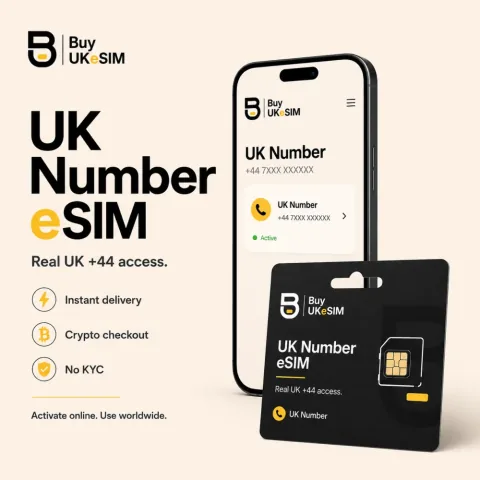
BuyUKeSIM sells a real UK +44 carrier line as an eSIM for accounts you intend to keep. For a single throwaway code, the free sites described here are the better choice.
Free SMS Verification Number Online
A practical method for getting a code out of a free public number, and an honest account of what that number cannot do afterwards.
- Check the public inbox before using a number. A wall of recent codes from your target platform means it is already burned.
- If no code arrives in a couple of minutes, rotate numbers rather than resending to the same one.
- Trying a different country can help, because platforms sometimes filter entire ranges.
- Anything sent to these numbers is readable by anyone, so never use them for accounts with value attached.
- You do not keep the number, so re-verification and password resets months later are where accounts are lost.
- For a single throwaway code, free sites are the cheaper and more sensible option, and we say so.
Free online SMS numbers work more often than their reputation suggests, provided you use them the way they are built to be used. Most people try one number, get nothing, and conclude the whole category is broken. In reality the numbers are shared and burn out at different rates, so success is largely a matter of picking a live one and rotating quickly when a code does not appear.
This page is the practical version: how to choose a number, how to tell it is already dead before you waste an attempt, and what to do when a code arrives late or not at all. Then, because it would be dishonest to stop there, it explains the one thing these sites structurally cannot do, and how to tell whether that thing matters to you.
How these sites actually work
A free receive-SMS site operates a pool of real numbers and publishes their inboxes as public web pages. Anyone can open the page, anyone can read the messages, and no signup is required. The numbers span several countries, and the same physical number may be listed on multiple sites at once, which is worth knowing because it multiplies how heavily each one is used.
Nothing about this is hidden or dishonest. The sites are upfront that the inboxes are public. The service they sell is convenience, funded by advertising, and for a single low-stakes code it delivers exactly that.
Why these numbers stop working, mechanically
Three separate mechanisms are at work, and they fail at different points. The first is the shared inbox: because the page is public, a code you request is visible to anyone refreshing it while it is live, and on popular numbers people do refresh. For a throwaway account that is an acceptable risk. For anything with money, messages, or identity attached, it is not.
The second is range reputation. Platforms score each verification request against the number's history, and these numbers carry thousands of prior signups, sometimes multiplied by being listed on several sites at once. Past a threshold the platform stops delivering, silently, with no error shown to you. Resending achieves nothing because the decision is attached to the number, and entire ranges are sometimes filtered together, which is why switching country can work when switching number does not. The third mechanism is timing: a message can arrive after the code window has closed, in which case request a fresh code rather than assuming the number is dead.
The thing free sites structurally cannot do
You never hold the number. It is shared while you use it and it stays in the pool afterwards, available to everyone. That is not a flaw in any particular site, it is the definition of the product.
The consequence is delayed. Months later a platform may ask for the same number again, at a new-device login, after a session reset, or during a password reset. The code goes to a public page that thousands of people can read, or to a number that has since been retired. Accounts fail here quietly and without warning, and the recovery route is often gone with the number. Judge free numbers on this timeline, not on whether today's code arrives.
So when should you not use a free number
Use free when the account is disposable. A one-off signup, a test account, something behind a phone wall you want to read once. In those cases free is cheaper and more sensible than anything on sale anywhere, and we would rather say that plainly than pretend otherwise.
Stop using free when the account is one you intend to keep, because at that point you need a number that is still yours at re-verification. That is what a real carrier line provides. Ours is a UK +44 mobile line delivered as an eSIM QR, unlimited incoming SMS and calls worldwide over roaming, no mobile data, $25 once with the first six months included and $15 every six months after that. Payment is in crypto, there is no account and no email, and no card is stored. We do not promise any specific app will accept it and we do not refund app rejection.
How to actually get a code from a free online number
- 1
Open two or three free receive-SMS sites in separate tabs before you start. You will need alternatives, and having them ready saves you from restarting the signup while a code window is ticking.
- 2
Load a candidate number's public inbox and read it. If it is full of recent messages from the service you are signing up to, pick another. Prefer numbers whose traffic is recent but varied, and newer listings where the site shows when a number was added.
- 3
Accept that the inbox is public before you commit. Every message on that page is visible to anyone who loads it, so only proceed with an account whose loss would not cost you anything.
- 4
Request the code, then refresh the public inbox rather than waiting for a notification, and enter the code as soon as it appears. If nothing arrives in roughly two minutes, switch numbers instead of resending, and switch country if several numbers in a row fail.
- 5
If the account has to survive, use a number you hold instead. Install our UK +44 carrier eSIM, register the account against that number, then test delivery once from an unrelated low-stakes service before you depend on it.
- 6
If your own line does not receive, run the checks in order: confirm the line shows signal, request a code from a different service to prove it receives at all, turn on Data Roaming for that eSIM line, dial *132# or *#100# on the line to read its own number back, and allow one to six hours, since registration takes that long on some networks.
Questions & answers
Why did my code never arrive on a free number?
Almost always because the number is flagged. Public numbers carry very large registration histories, and platforms use that history to decide whether to send anything. When a number is blocked the request appears to succeed and no message is delivered, with no error shown. Resending to the same number will not change the outcome. Pick a different number, ideally one whose public inbox is not full of recent codes from the same service.
Can other people see my verification code?
Yes. Free receive-SMS sites publish the inbox as a public web page, which is the entire mechanism, and they do not hide this. Anyone loading the page while your code is live can read it, and on popular numbers people are watching. This is tolerable for a disposable signup and unacceptable for an account holding money, private messages, or anything tied to your identity.
Are free SMS sites illegal or unsafe to visit?
The sites themselves are ordinary advertising-supported websites and using one to receive a code is not exotic. The risk is not in visiting them, it is in what you put behind the number. Treat every code you receive there as public information, do not use them for accounts you care about, and do not enter anything on the site itself. The safety question is about the account, not the website.
How long can I keep an account verified with a free number?
Only until the platform asks again. Sessions usually persist for a long time, so the failure is delayed rather than immediate. New-device logins, session resets, and password recovery all send a code to the number on file. If that number is public or has been retired, recovery fails or falls into a stranger's hands. Free numbers are best treated as a one-time key, not as a permanent one.
When is paying for a number actually worth it?
When losing the account would genuinely cost you something. At that point you are not buying a code, you are buying continuity of control over a number. Our UK +44 carrier line is $25 once with the first six months included, then $15 every six months, delivered as an eSIM QR seconds after your crypto payment confirms. It receives unlimited SMS and calls worldwide and carries no mobile data. Nothing auto-renews and no card is stored.
More topics
Free SMS Verification Number Online
A practical method for getting a code out of a free public number, and an honest account of what that number cannot do afterwards.
Buy UK eSIM - $25