
For anyone looking for an anonymous phone number, a number without ID, or a number for verification, anywhere in the world.
No-KYC phone number: what it means and what you actually get
Three different things are sold under this name. What each is good for, where each fails, and what skipping ID at checkout does and does not change.
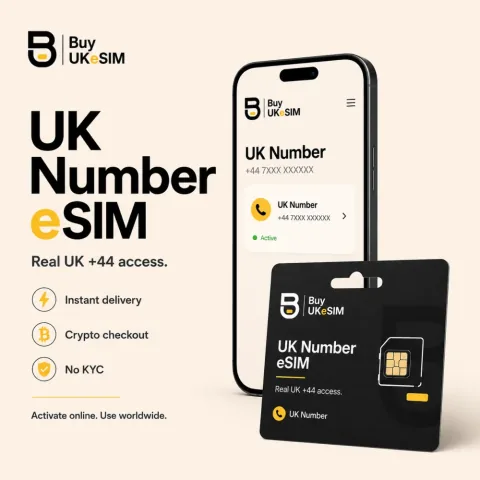
- No-KYC here means no ID document, no signup and no email required to buy, with crypto at checkout.
- Shared SMS sites suit a throwaway code. Rented VoIP suits a number you can afford to lose. A real carrier line suits an account you keep.
- The UK +44 line is $25 once for six months, then $15 per six months. Nothing renews on its own.
- It receives SMS and incoming calls and roams. No mobile data, no outgoing calls.
- The QR is single use and a deleted profile is never reissued. No provider can promise a given service accepts a given number.
- No-KYC removes the seller's record of you. It does not hide the number from the carrier or from the apps you use it with.
'No-KYC phone number' is used for three quite different products, and mixing them up is how people end up with a number that never receives the code they paid for. KYC stands for know your customer: the ID document, selfie, address or bank card a seller asks for before it will sell you something. A no-KYC number is one you can buy without any of that.
This page sorts the three kinds, says plainly what each is good and bad for, and then says what no-KYC does not do. Skipping ID at checkout removes one record, the one a seller would otherwise hold about you. It does not make a phone number invisible, and nobody can truthfully sell it that way.
What no-KYC means in practice
At BuyUKeSIM it means four concrete things. No ID document and no selfie. No signup. No email required. And payment in crypto, because a card payment would bring a billing name and address with it. You choose the line, pay, and the eSIM QR appears once the payment confirms on chain.
Two details keep that statement honest. The checkout has an optional email box, and if you type an address in it we store it with the order, so the accurate wording is no signup, no email required, not no email ever. And instead of an account you get an eight-character lookup code that opens your order later. Keep it: with no identity on file there is no other way back to the order.
Kind one: shared and temporary SMS sites
These are websites that show a public inbox for a pool of numbers, or rent a number for a single code. They ask nothing about who you are, they cost little or nothing, and for one throwaway sign-up you will never need again they are a fair choice.
The failures are mechanical. The inbox is a public page, so anyone loading it when the code arrives can read it. The number has been used for thousands of sign-ups before yours, so many services have already flagged it and the code simply never comes. And because you never held the number, a password reset or re-verification months later has nowhere to go, or goes to whoever holds the number now. Use this kind for accounts you can afford to lose.
Kind two: rented virtual and VoIP numbers
A virtual number is routed over the internet through an app or a web service instead of sitting on a mobile network. They are quick to get, often cheap, and some let you text and call from an app. That convenience is real.
The trade-offs are different from the shared sites. Many services check the type of a number, and some refuse VoIP ranges outright. Most providers want an account and a payment method, so check what yours asks for before treating it as no-KYC. The number is usually a rental, so when payment stops it goes back into a pool. And the messages pass through the provider platform, which you do not control. It suits a calling number you can afford to lose, less so an account you intend to keep.
Kind three: a real carrier line bought outright
This is a SIM or eSIM on a real mobile network with its own number. It registers as an ordinary mobile line, one holder uses it, it keeps working as long as it is paid for, and it works abroad through roaming. A reset or re-verification message six months later reaches you, because the number is still yours.
The costs are also real. It is the dearest of the three, it needs an unlocked phone that supports eSIM, the profile installs once, and the line sits on a carrier that keeps the records any carrier keeps. Our line has no mobile data. If you need a number for an account that has to survive, this is the kind to look at. If you need a code once, it is more than the job requires.
Where our UK +44 line fits
It is a real UK +44 mobile line delivered as an eSIM QR, dedicated to one buyer and unused when it is issued. You buy it outright rather than renting it per code. It costs from $25, which covers the first six months, then $15 for each further six months to keep it. Nothing renews on its own and no card is stored. It receives SMS and incoming calls, including while you roam. It does not include mobile data or outgoing calls.
Two rules are stated before purchase, not after. The install QR is single use, so a deleted profile is never reissued and you should contact support before deleting it. And there are no refunds if an app declines the number. Standard SMS verification works, but no provider can promise that a given service accepts a given number, and we do not.
What no-KYC does and does not hide
It hides one thing: we hold no ID document or name for you. That is a real reduction in what exists about you, and it is the whole claim.
It does not hide the rest. The carrier sees how the line is used, as every carrier does. Every app and website you give the number to sees it and ties it to its own account. SMS is not end-to-end encrypted, and the carrier carries it. Your phone still has an IMEI and your connection an IP address. This site runs minimal first-party analytics, and says so. On a transparent chain such as Bitcoin or the Ethereum family the payment is public for good, while Monero shields amounts and addresses at protocol level. If the requirement is that no record exists anywhere, a phone number is the wrong tool.
Which kind to choose
One throwaway code for an account you will not miss: a shared SMS site costs nothing. A quick calling or texting number where a refusal would not hurt: a virtual number. An account you want to keep, with codes arriving months from now and a number that must still be yours: a real carrier line. Decide by what happens when the number stops working, not by the price on day one.
How to buy a phone number without ID, step by step
- 1
Decide what the number is for
If it is one throwaway code, a shared SMS site asks nothing of you and costs nothing. Carry on only if the account has to survive re-verification later.
- 2
Check your phone
It must support eSIM and be carrier unlocked. Look for Add eSIM in the mobile settings, or dial *#06# and check that an EID is listed beside the IMEI.
- 3
Choose the line, no signup
Pick the UK +44 line on the site. There is no name field, no document upload and no account to create.
- 4
Pay in crypto
Choose a coin and send the payment. Monero is on the list if you want the payment itself shielded. The QR appears after the payment confirms on chain, and how long that takes depends on the coin.
- 5
Save the lookup code
Write down the eight-character code before you leave the page. It replaces an account and is the only way back to the order.
- 6
Install on the phone that will keep the line
Scan the QR once, on the device that will hold the number, and label the line so you do not delete it by accident. The QR is single use and a deleted profile is never reissued.
- 7
Test before you rely on it
Check for signal, dial *132# to read the number back, then request a code from a low-stakes service. If nothing arrives, turn on Data Roaming for the eSIM line and allow an hour or two for registration.
Questions & answers
What is a no-KYC phone number?
A number you can buy without the checks a seller normally runs: an ID document, a selfie, a billing address or a bank card. At BuyUKeSIM that means no ID, no signup and no email required, with crypto at checkout. It describes how you buy the number. It does not describe what happens to the number afterwards.
Is a no-KYC number anonymous?
Not fully, and we will not claim otherwise. The seller holds no ID for you, but the carrier sees how the line is used, every app sees the number, SMS is not end-to-end encrypted, and the site runs minimal first-party analytics. Treat it as no ID needed to buy, not as invisibility.
Can I use a no-KYC number for verification codes?
Standard SMS verification works, but no provider can promise that a given service accepts a given number, and we do not either. A real carrier line avoids the problems of shared and VoIP numbers, since it is dedicated to you and registers as an ordinary mobile line. Each service still decides for itself, and there are no refunds if one declines it.
Is a free SMS site a no-KYC number?
It asks for no identity, so in that narrow sense yes. But the inbox is public, the number is shared with many earlier sign-ups, and you do not keep it, so a later reset has nowhere to arrive. Fine for a throwaway account, wrong for one you want to keep.
Are VoIP and virtual numbers no-KYC?
It depends on the provider, so read what yours asks for: many want an account and a payment method. Separately, many services check number type and some refuse VoIP ranges. A virtual number is usually a rental, so it can go back into a pool when you stop paying.
Are there no-KYC eSIM providers?
Yes, several sellers offer eSIMs without an ID check, and they differ in what they deliver: some sell travel data only, others a number. We compare them side by side on /no-kyc-esim-compared/ and make no claim to be the only one. Check what each includes before you pay.
Do I need an email or an account?
No signup and no email are required. The checkout has an optional email box, and if you fill it in the address is stored with the order. Without one, your eight-character lookup code is how you open the order later, so save it. See /buy-phone-number-without-id/ for the full no-ID walkthrough.
What happens if I delete the eSIM or lose the code?
The QR is single use. If the UK profile is deleted the line is gone and it is never reissued, so contact support before deleting it. With no identity on file, a lost lookup code cannot be recovered either. Save the code when you first see it.
More topics
Related guides
No-KYC phone number: what it means and what you actually get
Three different things are sold under this name. What each is good for, where each fails, and what skipping ID at checkout does and does not change.
Buy UK eSIM - $25