
For XMR holders in the UK, the EU, the USA, Turkey and worldwide.
Buy a UK number with Monero
The one coin here whose payment leaves no public ledger entry tying your wallet to the order.
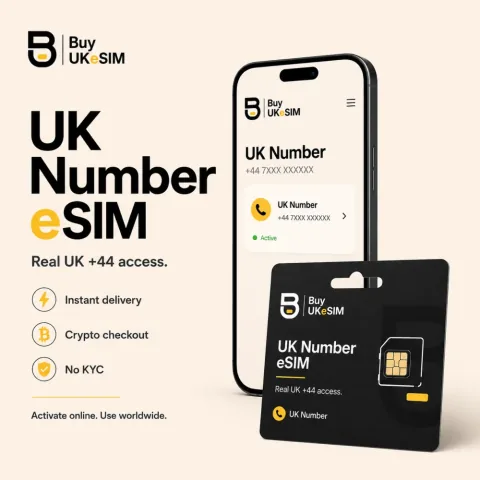
- Pay in XMR, one of 12 accepted cryptocurrencies
- No name, identity document, card or account collected at any point
- Monero shields amount and addresses at protocol level; the transparent chains do not
- Real UK +44 carrier line for incoming SMS and calls, not VoIP
- Measured here: about 25 minutes end to end, against roughly 5 for USDT on TRC20
- Privacy at checkout, with the limits named rather than glossed over
You can pay for a real UK +44 mobile line in Monero, alongside eleven other coins. What separates XMR from the rest of that list is not the price and not the speed. It is what the payment leaves behind afterwards.
This page is deliberately specific about where that privacy starts and where it stops. Monero changes the payment. It does not change what a mobile network sees once the eSIM is installed, and no seller can change that.
What Monero changes, and what it does not
Bitcoin, Ethereum, USDT, USDC, Solana, Tron, BNB and Dogecoin all settle on public ledgers. The amount, the addresses and the timing are permanent and searchable by anyone, forever. If one of your addresses is ever linked back to you, that purchase is linked with it. Monero shields amounts and addresses at the protocol level, so the payment does not create that record in the first place.
Here is the part most pages leave out. The product is a real carrier mobile line, and a mobile network necessarily sees the IMSI of the profile, the IMEI of the handset it runs in, which cell it attaches to, and call and message metadata. That is how mobile networks work. It is not a property of the coin you paid with, and paying in XMR does not alter any of it.
What we can say about our own side is narrow and checkable: no name, identity document, card or account is collected at any point, so none exists here to leak or to hand over. An order is found by a code. The practical linkage risk that remains is correlation, chiefly the handset's IMEI being shared with an already identified line in the same phone.
Why Monero is the strongest privacy option we accept
Monero is not a transparent chain with privacy bolted on as an option. Three properties are on by default for every transaction: a one-time stealth address, so the address you were given never appears on the chain; ring signatures, so the real spend sits among decoys rather than pointing at one wallet; and confidential transactions, so the amount itself is encrypted. Nothing has to be switched on and there is no optional shielded mode to forget.
That is what makes it the right match for how this checkout is built rather than just another coin on the list. We collect no name, no identity document, no card and no account - but on Bitcoin, USDT or any other transparent chain, that restraint is only half the story, because the payment still writes a permanent public entry that a future analysis can attach to you. Monero is the only option here where both halves line up: nothing collected on our side, and nothing published on the chain's side.
It is the same reason the coin appears by name in our published threat model rather than in marketing copy. We put it there because the distinction is technical and checkable, not because it sounds good.
How long a Monero payment actually takes here
Measured on this site's own Monero orders: about 25 minutes on average from opening the invoice to the QR appearing, with most landing between 11 and 42 minutes. Most of that is the protocol rather than us. The Monero network alone has a median confirm wait of 18.6 minutes, against 1.0 for USDT, and a USDT payment averages around 5 minutes end to end on the same measurement. That gap is the honest trade, and it is worth knowing before you choose the coin rather than after.
The reason is confirmation depth. Monero waits for more blocks before a transfer is treated as settled, which is the same property that makes it hard to reverse. Nothing is stuck and nothing needs chasing during that window.
Practically: send the exact amount shown, then leave the order page open. It updates itself the moment the network confirms. Do not send a second transfer because the first is taking longer than a card payment would - a duplicate crypto payment has to be refunded by hand and is far slower to resolve than waiting.
Where Monero sits among the twelve coins we take
If your priority is getting the number as quickly as possible for the smallest network fee, USDT on TRC20 is the better pick and we say so on its own page. If your priority is that the payment itself does not become a permanent public record, Monero is the only option on the list that gives you that, and the extra twenty minutes is the price of it.
Either way the product is identical. The same +44 line, the same one-time price, the same QR on the same order page. The coin changes the trail the payment leaves, not what you receive.
Paying for a UK number in XMR
- 1
Pick the line and the prepaid term
Choose how many lines you need and whether to prepay 6, 12 or 24 months. Longer blocks cost less per month.
- 2
Choose Monero at checkout
The order page shows the exact XMR amount and the address to send it to. The amount is fixed at that moment, so send what it shows rather than rounding.
- 3
Send from your wallet
Any Monero wallet works. Some exchanges have delisted XMR, so a self-custody wallet is the usual route.
- 4
Leave the page open
It refreshes itself while the network confirms, usually under 20 minutes on Monero. Do not send a second transfer.
- 5
Install the QR
The QR appears on the order page once confirmed. Turn any VPN, iCloud Private Relay or Private DNS off while you install the eSIM, then turn it back on.
Questions & answers
Does paying with Monero make the number untraceable?
No, and nothing on this page should be read that way. Monero keeps the payment off a public ledger. The line itself is a real carrier line, so the mobile network still sees the profile's IMSI, the handset's IMEI and which cell it attaches to. What changes is the payment trail, not what a carrier records.
Why does Monero take longer than USDT here?
Confirmation depth. Measured on our own orders, XMR averages about 25 minutes end to end and usually lands between 11 and 42, while USDT on TRC20 averages around 5. The network itself is the bulk of it: a median confirm wait of 18.6 minutes against 1.0 for USDT. The wait is the cost of the protocol-level privacy.
Do you keep any record of the order?
An order record exists so you can reopen your QR later with your code, and an email address only if you chose to give one for delivery. No name, identity document, card or account is collected, so none of that exists to be requested or leaked.
Can I send XMR from an exchange?
If your exchange still supports Monero withdrawals, yes. Several have delisted it, so most buyers send from a self-custody wallet instead. Either works as long as the exact amount arrives.
More topics
Buy a UK number with Monero
The one coin here whose payment leaves no public ledger entry tying your wallet to the order.
Buy UK eSIM - $25